
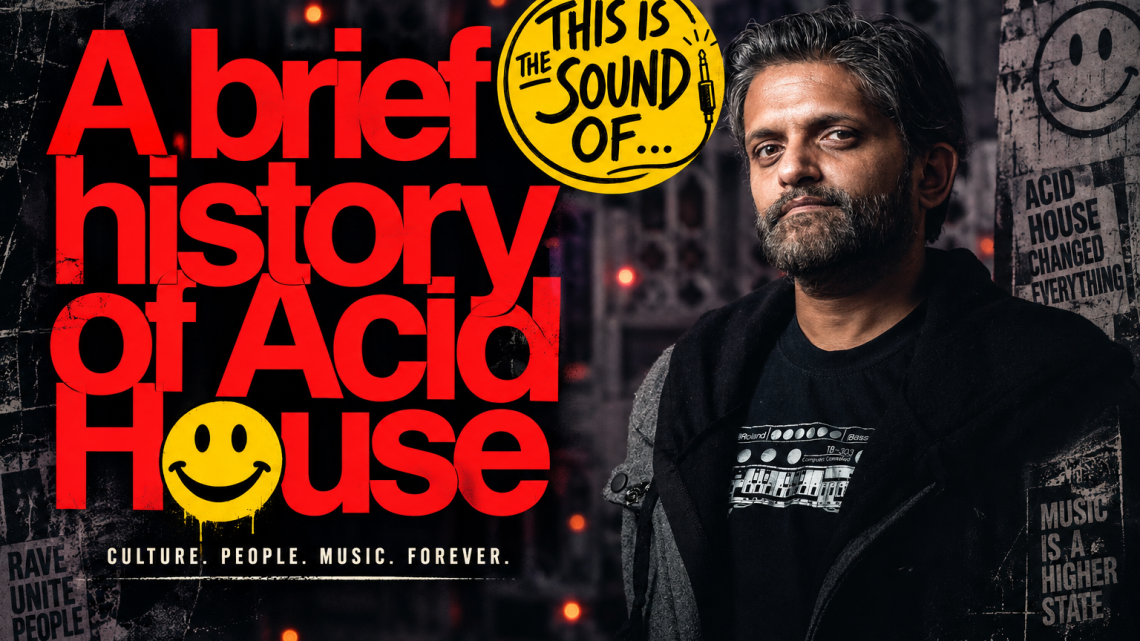
Suddi Raval: This Is The Sound Of… Acid House, Hardcore Uproar And A Lifetime Inside The Machine
September 21, 2026Interview Mike Moggi Mannix
From Manchester’s warehouse revolution and the Hacienda to Hardcore Uproar, videogame soundtracks and a new cinematic podcast series, Suddi Raval has spent almost four decades following the machines wherever they lead. Now he’s turning the history he lived into something you can hear, feel and almost step inside.
There are people who remember Acid House, people who documented Acid House, and then there are people for whom Acid House seems to have permanently altered the wiring. Suddi Raval sits firmly in that last category. Growing up around Manchester, he encountered the sound as a teenager and became immersed in the culture as it exploded through clubs, warehouses and illegal parties across the North of England. Through that world he met Jonathan Donaghy and formed Together, responsible for the 1990 rave anthem “Hardcore Uproar”, a record that became synonymous with the Hacienda and the warehouse generation. But reducing Raval to one seminal record misses most of the story. He went on to compose and design audio for videogames, teach music history, continue making acid, house and electro, and later write and illustrate A Brief History of Acid House, documenting the machines, clubs, people and social forces that shaped the movement.
Nearly four decades after first hearing that alien 303 squelch, Suddi hasn’t grown remotely tired of explaining why it mattered. His latest project, This Is The Sound Of…, combines music history, original production, interviews and the immersive sound-design techniques he developed through videogames. Acid House naturally sits at the centre, but the series also moves through techno, hip-hop, jungle and other genres that shaped his life. What struck me immediately when we spoke was that Suddi himself may be one of the project’s greatest assets. His enthusiasm comes blasting through. This isn’t somebody standing outside the culture explaining what happened. This is someone who lived it, still gets visibly excited talking about it and has now found a completely new way to tell the story.
Episode_Art_Acid_House
FROM THE BOOK TO SOMETHING YOU CAN HEAR
Our conversation starts more like two old friends reconnecting than an interview formally beginning.
Mike Mannix: “Good to hear from you, man. It’s been a long time.”
Suddi Raval: “Yeah, yeah, it’s been quite a while.”
I ask him how life in the fast lane is treating him and he immediately starts talking about the projects he’s been immersed in, particularly videogames. His involvement has now expanded beyond simply creating audio and into aspects of making the games themselves, although sound remains central to everything. I get straight to the reason we’re talking.
Mike Mannix: “Tell me about this fantastic project. How did it begin from the book?”
Suddi traces it back to A Brief History of Acid House, which he wrote around eight years ago.
Suddi Raval: “It’s amazing so much time has passed. I thought about the different skills I’ve got. I worked at the BRIT School doing teaching, so I was telling the history of music. Then there was the writing, the videogame experience bringing sound design in, and obviously I make music. It’s like four different industries which I’ve dipped into to try and make something a bit different.”
That combination is what gives the series its personality. Rather than creating a conventional interview podcast, Suddi approaches each episode almost cinematically. Narration tells the story, interviews bring in lived memories, original music establishes the atmosphere and sound design helps transport the listener into the world being discussed. The original idea was deliberately compact. Acid House, techno, jungle, hip-hop — little bursts of musical history that people could consume quickly.
Suddi Raval: “I used to call them bus pods. You could listen to one while you wait for the bus.”
I laugh.
Mike Mannix: “Very good. I like that name. A little burst of ten minutes of music knowledge.”
The problem is that people keep asking him to make them longer.
THEN DJ PIERRE PICKED UP THE PHONE”
Things went onto another level when Suddi’s friend Stephen Dobson suggested he contact DJ Pierre.
Suddi Raval: “He said, ‘Buddy, you get in touch with Pierre.’ And for me that was like contacting God. I was like, ‘Oh my God.’”
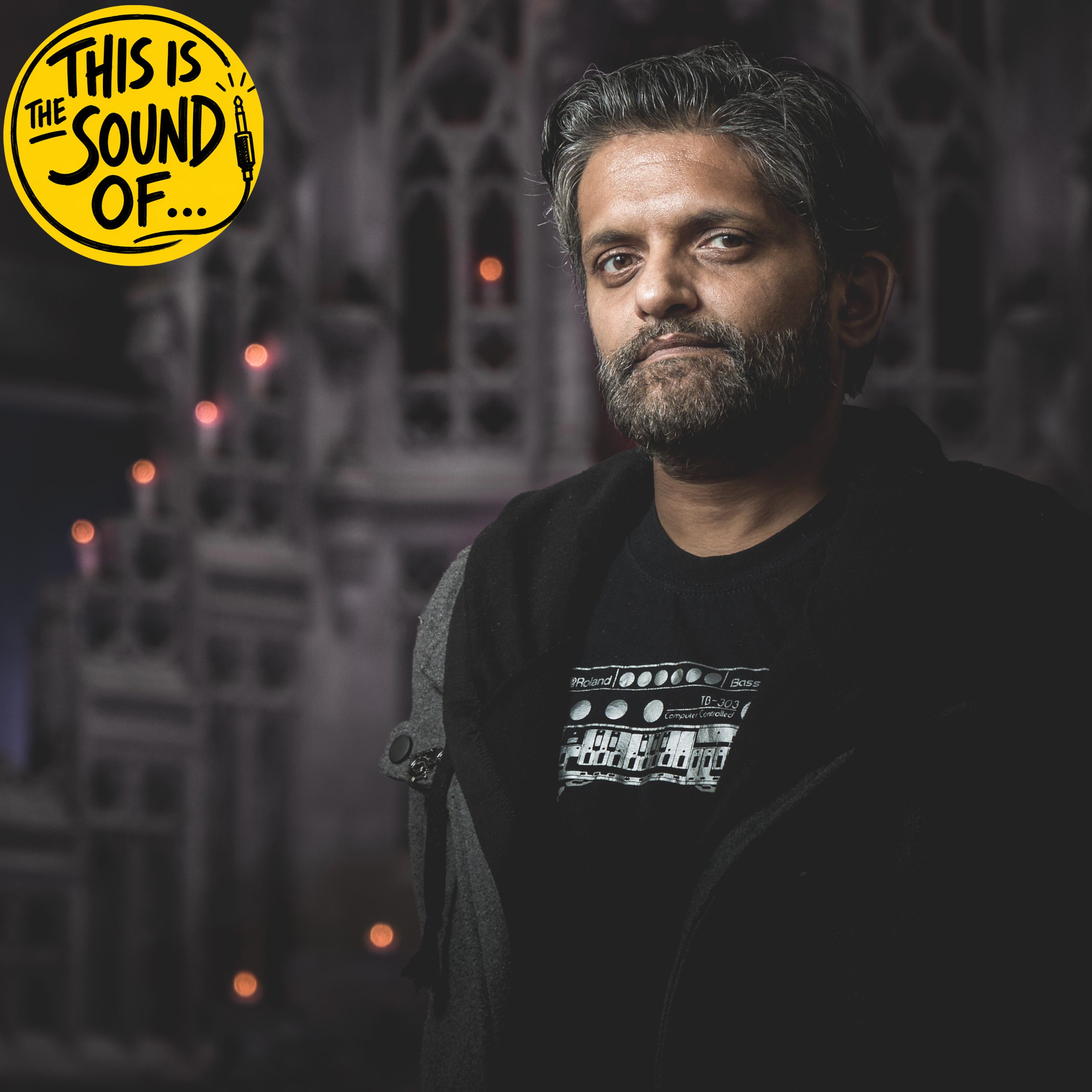
Host_Suddi_Raval Photography Paul Husband
For Suddi, Pierre isn’t simply another interview subject. As part of Phuture, he stands right at the source of the music Suddi has been obsessed with since he was 16. Pierre agreed to talk — and then apparently gave Suddi far more than he ever expected.
Suddi Raval: “He gave the best interview ever. I was thinking, wow, I’ve heard every interview he’s ever done. I wasn’t expecting anything so fresh, so new.
He was just coming out with more and more because he was so relaxed. Absolute gems.”
There was so much material that the interview had to be broken across different installments. Suddi hints at controversial stories and one particular revelation connected to Pierre’s childhood that he refuses to spoil. You can hear how much he’s enjoying having information even he had never heard before.
Pierre eventually told Suddi that he’d obviously done his research.
Suddi Raval: “I felt like saying to him, mate, you’ve no idea.”
Because this isn’t research gathered over a few weeks. Suddi has lived with Acid House for most of his life.
Suddi Raval: “I didn’t care if it was fashionable or not. I just loved it from the age of 16. I heard it and it was just the most addictive thing for me. I got obsessed with it and never let go.”
That obsession is really what powers the whole thing.
THE PRESENTER WHO DIDN’T WANT TO PRESENT
Ironically, Suddi originally didn’t even want to narrate the series himself.
Suddi Raval: “I was worried people would think I’m trying to be some kind of narrator or presenter, which I wasn’t interested in doing. It was just telling the stories.”
His mates told him otherwise. I agree with them.
Mike Mannix: “You’re a natural presenter, dude. If I was in the BRIT School, I’d want to be taught by someone like you because you animate it. You make it interesting.”
I jokingly slip into the voice of some painfully dry historical documentary — “and the year of Acid House started in…” — and we both laugh. That’s the thing. Suddi doesn’t sound excited because he’s trying to perform excitement. He genuinely still gets excited by the history. The response he’s received has reinforced that. People from broadcasting and journalism backgrounds have told him that the format sounds different. Part of that comes directly from his videogame experience. When telling the story of Detroit, for example, he uses abstract sound and atmosphere rather than simply relying on words.
Suddi Raval: “I’m bringing sounds which are just kind of abstract noises, but they totally capture the feel of it.”
Someone compared the approach to older BBC productions where the sound itself became part of the storytelling.
Suddi Raval: “I did something a little bit unusual without realising I was.”
That’s probably the sweet spot. Suddi isn’t a broadcaster discovering rave culture. He’s a rave obsessive who happens to have decades of professional sound-design experience.
ACID HOUSE AS CINEMA
Listening to him describe it, I immediately start seeing the visual possibilities too. His original book has a brilliant illustrated style, and I ask if that could eventually become part of the podcast through Reels, animation and short video pieces.
Mike Mannix: “The way you did the artwork, which is brilliant for the book — if you do visuals, could you have representations in that style? People will just go, ‘Fuck.’ You’ll capture a whole younger audience.”
Suddi completely agrees, but the problem is workload.
Suddi Raval: “I absolutely want to do video, but when I started doing it I realised I’m just never going to get this out.”
So for now the priority is simple: get the audio released, then develop the visual side later. There is already some basic YouTube material because, as he quickly discovered, a huge amount of podcast listening happens there. The ambition is still much bigger.
Suddi Raval: “I absolutely intend to do the proper video version because there’s some great stories still to be put out. So many little gems.”
Once the different Acid House episodes are assembled, Suddi can even imagine the project becoming something closer to a full-length documentary. Those little “bus pods” are quietly turning into something much larger.
“WE’RE WEIRD IN THE ACID COMMUNITY”
Another smart element is Suddi’s decision to bring academics into the series alongside producers, DJs and people who actually lived the culture.

He doesn’t only want people saying Acid House was brilliant. He wants different perspectives on why it mattered and what made the music unusual. One academic made an observation that particularly struck him: unlike almost every other genre, the fundamental language of acid has barely changed. Rock evolves. Jazz evolves. Funk evolves. Even house has changed dramatically. But the essential Acid House formula remains remarkably recognisable — a solid rhythm and a TB-303 being pushed into strange territory.
Suddi Raval: “Acid is still the same instrument. It’s got a very similar value and energy. You pretty much describe it the same way as you did 30 or 40 years ago.”
Then comes the perfect conclusion.
Suddi Raval: “We’re weird in the acid community. We don’t need change. We like it. It was spot on the first time.”
I laughed because he’s right. Strip everything back and the core idea remains extraordinarily simple.
Suddi Raval: “At the end of the day, the best of it is the stuff that gives you
a good solid beat and a good 303 line.”
FORTY YEARS? NO CHANCE
Then I bring up something neither of us particularly enjoys thinking about. The approaching 40-year anniversary of Acid House.
Mike Mannix: “I think it’s no coincidence that all this is starting to come out as we come up towards 40 years of Acid House.”
Suddi sounds genuinely horrified by the arithmetic.
Suddi Raval: “I never thought that was going to happen. And now we’re talking about 40 years. It’s just too crazy. I’m not old enough for that.”
Mike Mannix: “I know, man. It’s too crazy.”
Then he tells me a brilliant little story about his mum. Whenever she sees the classic smiley face, she immediately associates it with Acid House.
Suddi Raval: “She points at it and says, ‘Look, it’s the acid.’ And I’m going, ‘Yes, that’s right, Mum.’ When I was a kid there was a smiley face everywhere. She asked what it meant and I said, ‘Oh, it means acid.’ That’s it.
It just means acid.”
It’s funny, but it also says everything. The symbol stuck. The machine stuck. The music stuck. And Suddi’s obsession certainly stuck.
Suddi Raval: “It’s in my veins and in my blood. I’m still not done with telling the stories of it. Finding new formats and new ways.”
THE KID IS STILL IN THERE
At this point I find myself talking almost as much about Suddi’s personality as the podcast itself. Because that’s what I think people are going to connect with.
Mike Mannix: “You’ve got the enthusiasm of a kid, but you’ve got life experience with it now. You’ve got the skills behind it, the knowledge. You’ve lived and breathed the scene.”
There’s a huge difference between someone repeating something they’ve researched and somebody remembering how it actually felt. Suddi remembers the Hacienda, the warehouses, the music and that moment when these records still sounded completely alien. I tell him that’s what gives his voice conviction.
Mike Mannix: “People will listen and go, that cunt’s talking with conviction. And you’re just like, tell me more. Tell me more. Tell me more.”
Suddi cracks up.
Mike Mannix: “I think it’s going to be a massive success, Suddi. Big time.”
He admits he’d worried about sounding too unpolished, so he played the episodes to the toughest critics possible: mates who will tell you straight if something is shit.
The response surprised him.
Suddi Raval: “I thought I’m just going to sound like a big kid who’s over-excited, but it’s kind of working.”
I think that’s precisely why it works.
FUCK POLISHED
We end up talking about how much media itself has changed. For decades, traditional broadcasters aimed for polished delivery, clean edits and perfectly controlled presentation. Younger audiences have grown up with YouTube, gaming content, jump cuts and people talking directly into cameras without pretending everything is immaculate.
Mike Mannix: “Polished production and fine editing has been done for fucking decades by the BBC and the kids got bored of it.”
I tell Suddi about watching my 11-year-old consume gaming videos. Sometimes I look at the production and think it’s terrible. His response is basically: you’re old.
Mike Mannix: “I’m looking at it going, ‘That’s crap.’ And he’s like, ‘You’re old. I love this.’”
But I can also see why it works. The personality hooks people.
Mike Mannix: “It’s like having a favourite teacher in school. It didn’t matter what they were talking about. They could be talking about paint drying. You’d still want to listen.”
And that, to me, is where Suddi fits perfectly. He’s not some slick presenter arriving to lecture younger listeners about what happened decades ago. He’s the bloke who was actually there and still sounds slightly amazed by it himself.
BUILDING HISTORY WITHOUT STEALING HISTORY
The series also presents a practical challenge: music licensing. Suddi can’t simply fill an independent podcast with every famous acid, techno, hip-hop and jungle record needed to illustrate the history, so instead he creates original music that captures the atmosphere without directly copying it.
The jungle episode made him particularly nervous. He brought in Mark XTC and jungle historian Julia Toppin, but before releasing anything he sent it to friends who truly live and breathe jungle.
Suddi Raval: “I contacted a few mates who live for jungle in the same way as I live for Acid House.”
He didn’t tell them what to think. He just sent it over. They loved it.
Suddi Raval: “That’s one of the tricky things. I can’t just licence all the actual music. So I’ve created the vibe.
Actual junglists have given it their thumbs up.”
That approval mattered. If you’re telling the story of somebody else’s musical culture, authenticity isn’t optional.
FORTY STORIES AND COUNTING
The project has grown considerably beyond the original idea. Acid House came first, followed by hip-hop and techno, with jungle among the next episodes. Suddi has around 40 instalments planned and the ten-minute format is already stretching towards twenty and potentially thirty minutes because listeners keep asking for more.
What strikes me is how perfectly This Is The Sound Of… brings together every apparently separate part of Suddi’s career: the teenager discovering Acid House, the Hacienda and warehouse years, Together and “Hardcore Uproar”, videogames, sound design, teaching, writing, illustration and decades of electronic music production.
Suddenly none of those things look disconnected. They look like preparation.
Suddi Raval: “When I started doing it, I was just like, wow, I should have done this sooner.”
There are already further possibilities developing around the podcast, although he’s keeping quiet about exactly what they are. What he isn’t keeping quiet about is his enthusiasm. And that may ultimately be what makes the project work.
HARDCORE STILL IN THE BLOOD
Towards the end, Suddi admits just how much work went into creating everything.
Suddi Raval: “Halfway through it I was like, ‘Oh my God, this is loads of work.’ But then I listened back and thought, actually, I’m glad I did it. It was worth the work.”
That feels like a fitting way to understand Suddi Raval’s relationship with Acid House itself. Almost four decades after becoming obsessed with the sound, he’s still asking questions, discovering stories, building machines and trying to explain why something that happened to a generation of teenagers in warehouses and clubs became so culturally important.

But this doesn’t feel like nostalgia. Nostalgia tries to take you back to something that disappeared. Suddi’s work suggests Acid House never really disappeared at all. Its ideas were absorbed into modern club culture so completely that generations now live among its consequences without necessarily knowing where they originated. And here he is in 2026, not embalming the history, but finding another way to remix it.
Sound design instead of dry chronology. Academics beside ravers. DJ Pierre beside personal memory. Original music replacing licensing impossibilities. Short-form storytelling designed for a completely different media age. By the end of our conversation I’m genuinely excited for where it could go.
Mike Mannix: “I’m excited for the future for you.”
Suddi Raval: “Nice one.”
And afterwards, one thing stays with me. Despite the records, the Hacienda, the warehouses, videogames, books, teaching, sound design and nearly four decades of music, Suddi still talks about Acid House like somebody has just handed him his first record. The technology changed. The audience changed. The media changed. Suddi changed. The 303 didn’t. And somewhere underneath it all, neither did the feeling.
Forty years? Forget it. As far as Suddi Raval is concerned, the party is still happening.